The Great Filter
The Universe is huge. There are a billion stars, planets, and possible earth-like worlds. So if life can happen easily, and intelligent civilizations can survive long enough, we might expect the universe to show signs of advance life.
But we do not see clear evidence.
The silence behind that creates the fear behind The Great Filter.
I’ve always felt that there could be two versions of this, a positive/hopeful version, and a negative/ darker version.
1.) The filter is behind us
This would be the hopeful version, maybe the hardest step was the origin of life, the jump from these simple cells to complex cells, consciousness, language, and technological civilization. If humanity already passed the hardest part, then we may be rare and lucky.
2.) The filter is ahead us
Now this is the darker version. Maybe these civilizations commonly reach our level, but then destroy themselves before becoming stable and long-term societies.
That great "Filter" could be a nuclear war, climate collapse, or some technology that we do not understand yet.
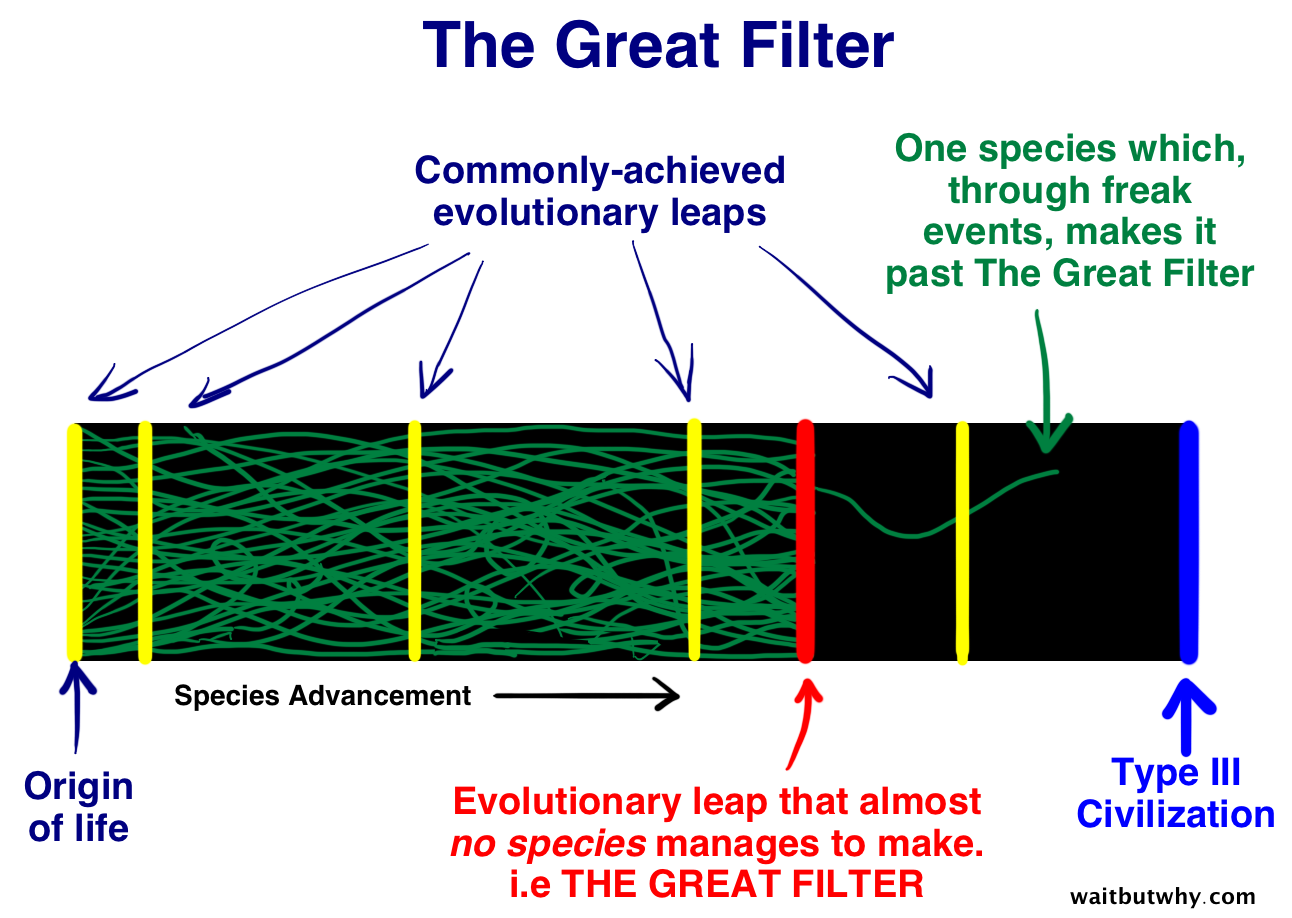
The Great Filter as a Theory of Civilization Self-Destruction
A society can be brilliant and still suicidal. It can map the genome, split the atom, land machines on other planets, build global communication networks, simulate intelligence, and still fail at the basic act of cooperation. The Great Filter becomes terrifying because it does not imagine civilization collapsing from lack of knowledge. It imagines civilization collapsing from knowledge without wisdom needed to survive.
This is the main fear that: progress is not automatically survival.
Robin Hanson’s Great Filter theory begins with the silence of the universe. If life can become intelligent, technological, and expansionary, then why do we not see evidence of advanced civilizations? Hanson’s question is not only astronomical. It is existential. Somewhere between dead matter and expanding life, there may be a barrier so severe that almost no civilization passes it. The disturbing possibility is that the barrier is not behind us, but ahead of us. https://mason.gmu.edu/~rhanson/greatfilter.html?
Every technological breakthrough is double sided. The same intelligence that lets a species survive, nature may eventually allow it to overpower itself.
Nuclear weapons are one of the clearest examples. Humanity became intelligent enough to understand the structure of matter, then immediately turned that knowledge into a weapon capable of destruction to an immense scale. The Bulletin of the Atomic Scientists describes the Doomsday Clock as a warning about “dangerous technologies of our own making,” and in 2026 it set the clock at 85 seconds to midnight, the closest it has ever been to catastrophe. Its listed concerns included nuclear weapons threats, artificial intelligence, biological risks, and the continuing climate crisis. https://thebulletin.org/doomsday-clock/
That image matters. Humanity is not threatened by some ancient evil monster outside the gates. The threat is engineered, funded, and upgraded by civilization itself. In all cases... something you and I have no choice or control over.
Climate change makes the fear even stranger because it shows that intelligence does not guarantee action. Society can understand a danger and still continue feeding it. The IPCC’s 2023 Synthesis Report states that human-caused climate change is already producing widespread impacts and risks, and that future risks rise with continued warming. The horror is not that we do not know but that knowing is not enough in itself. https://www.ipcc.ch/report/ar6/syr/
This is where the Great Filter becomes more psychological. A civilization can be smart enough to diagnose itself, but too addicted, divided, profitable, or politically corrupt to treat itself. It can watch the warning signs arrive in real time and still behave as if the system will somehow save itself. I am not educated enough in this to form an opinion on and let it be as is currently.
Artificial intelligence adds another layer because it may represent intelligence becoming detached from the mainl creature that created it. In 2023, the Center for AI Safety released a statement signed by many AI researchers and public figures saying that extinction risk from AI should be treated as a global priority alongside pandemics and nuclear war. Whether one sees that as likely or speculative, the fear fits perfectly: what happens when a species creates a form of intelligence faster, more scalable, and potentially less human than itself before it agrees on what intelligence is supposed to serve and just be? (Center for AI Safety)
The scariest part is not simply “AI kills humanity.” That is too cinematically neutral. The more unsettling version is that humans build systems they no longer understand, then reorganize society around them anyway. Markets already move faster than human judgment. Algorithms already shape attention. Social platforms already manipulate emotion at planetary scale. Machine learning systems already influence labor, warfare, art, language, finance, policing, and mainly desire. I dont think the filter may arrive as one final explosion. It may arrive as a slow transfer of control.
This is why communication networks are also double sided. The internet could have been treated as a planetary nervous system: a way for knowledge, empathy, education, and cooperation to scale across borders. Instead, it also became a machine for distraction, propaganda, loneliness, comparison, surveillance, and identity performance. The tool that should have made humanity more coordinated made it more fragmented.
A civilization does not need to be stupid to destroy itself. It only needs to become powerful faster than it becomes wise. It only needs to solve technical problems faster than moral ones.
Conclusion
Maybe the sky is quiet today because the universe is young. Maybe life is rare. Maybe interstellar expansion is way harder than expected. But the darker possibility is that technological civilizations keep reaching the same threshold: they become brilliant, connected, industrial, and godlike, then fail to control what they have made from greed.
For me, this makes the great filter turn all progress into one big question mark:
Every invention asks: does this make us more alive, or just more powerful? Does this thing expand human possibility, or does it just increase the scale of human failure? Are we becoming a mature civilization?
Maybe advanced societies do not disappear because they are weak. Maybe the universe is silent because intelligence is not the opposite of extinction. Maybe intelligence is the path that leads a species to it.